Laser, radiofrequency, foam or surgery: a trial comparing all four on the same day
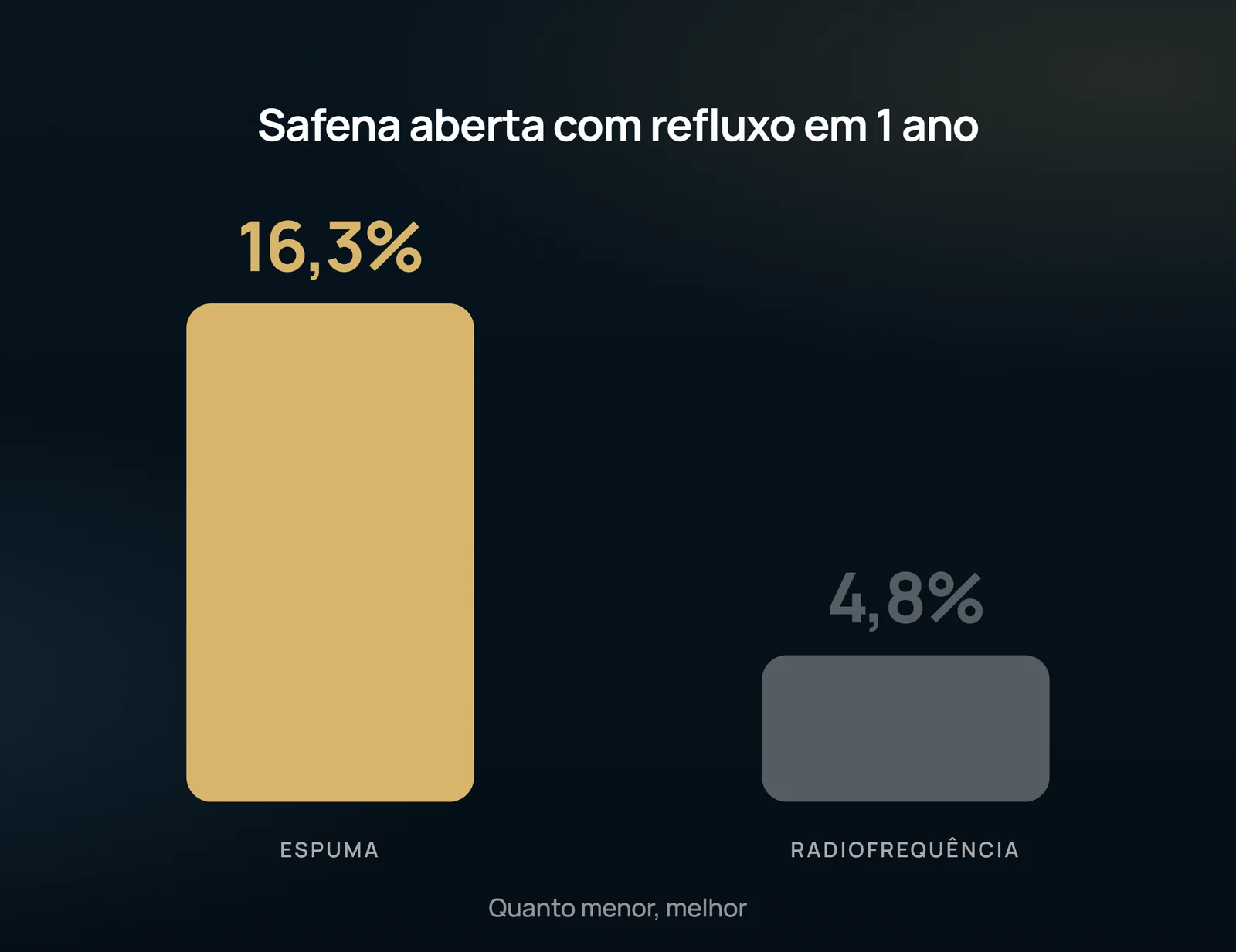
Five hundred consecutive patients, 580 legs, four arms and one year of follow-up. Foam failed about three times as much — and it was, along with radio frequency, the least painful method. The article does not elect a winner.
 View the video lesson
Removing the great saphenous vein was, for decades, the standard treatment of the stem varicose veins. When the intravenous laser, radiofrequency and foam sclerotherapy arrived, each was tested against surgery in separate trials — never the four in the same study. This study randomized 500 consecutive patients, with 580 legs with reflux of the great saphenous vein, for the four treatments, all under local anesthesia tumescent, with duplex before the procedure and again after 3 days, 1 month and 1 year.
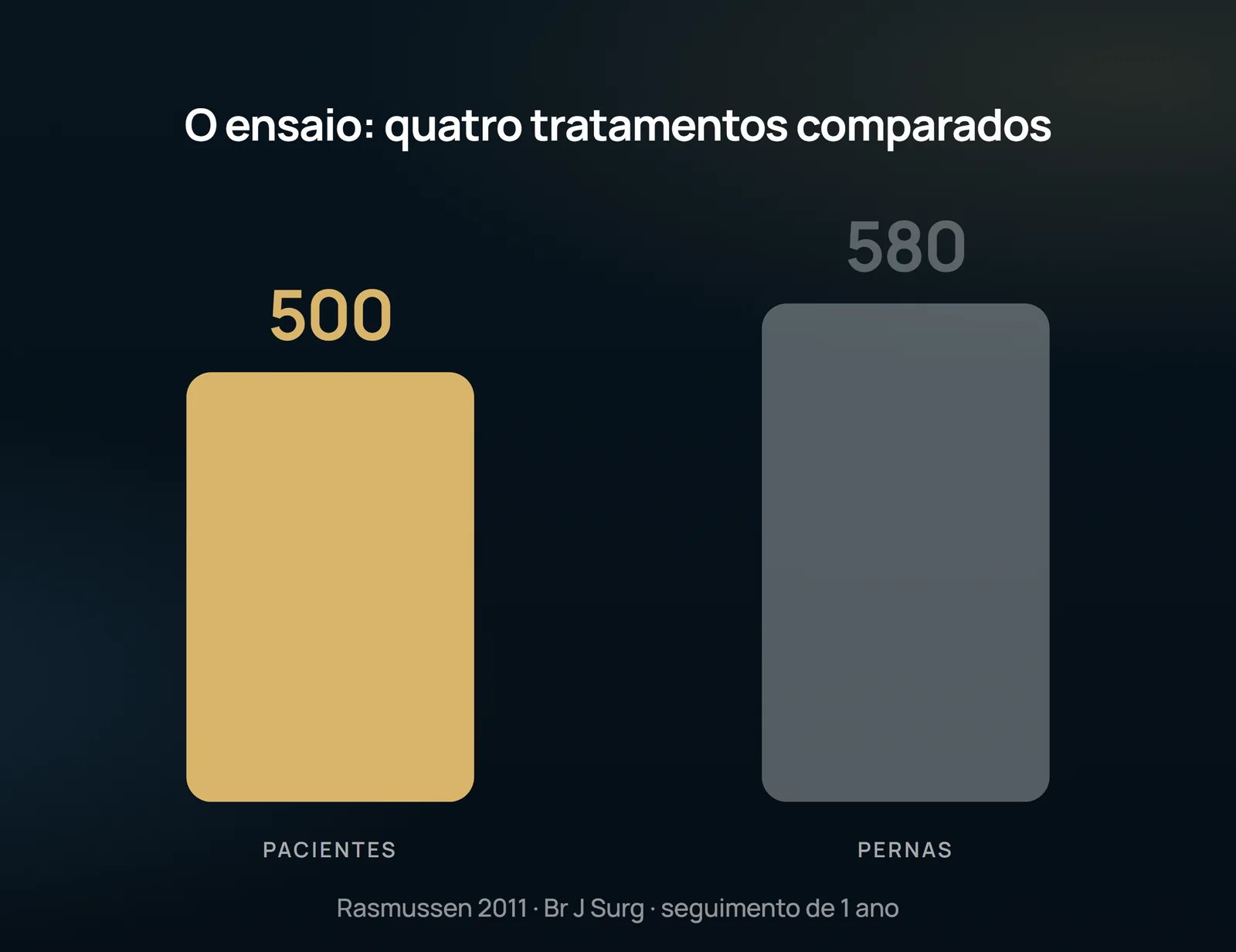
Endovenous laser, radiofrequency and ultrasound-guided foam sclerotherapy had already faced conventional surgery in separate trials. What was missing was direct confrontation: the four methods, in the same protocol, in the same centers, with the same operators. This is what Rasmussen and collaborators published in the British Journal of Surgery in 2011.
The drawing
Between February 2007 and July 2009, 500 consecutive patients (580 legs) with great saphenous reflux were randomized into blocks of 12 envelopes sealed for EVLA, RFA (ClosureFAST), sclerotherapy with ultrasound-guided foam or high stripping ligation. The four arms were performed in the operating room, under local tumescent anesthesia with 0.1% lidocaine with adrenaline and bicarbonate, with mild sedation — including open surgery. Miniphlebectomies were performed in all groups in the same session. The three surgeons had, before the beginning of the study, more than 100 EVLA procedures, more than 100 foam treatments, 25 ClosureFAST and more than 1000 strippings.
In the laser arm, the naked tip fiber (980 nm in the first 17 patients, 1470 nm in the rest) was advanced up to 2 cm below the saphenofemoral junction, with an average energy of 76.5 J/cm (43-128). In radiofrequency, the heating element of 7 cm maintained 120° for 20 s per segment, with the catheter also 2 cm from the junction. In foam, a 5-Fr tube above the knee and 3% polydocanol, 2 ml solution for 8 ml of air by Tessari method, with an average of 8 ml (4-15) per leg.
The primary outcome separates foam from the other three
The significant difference is entirely from foam: between laser, radiofrequency and stripping there was no statistical difference (P = 0.543). Five saphenous of the foam group that were open in the first month were portrayed, and after that no additional sclerotherapy was allowed by the protocol — the authors themselves raise that extra sessions would have reduced the failure rate.
In pain and recovery, the order reverses
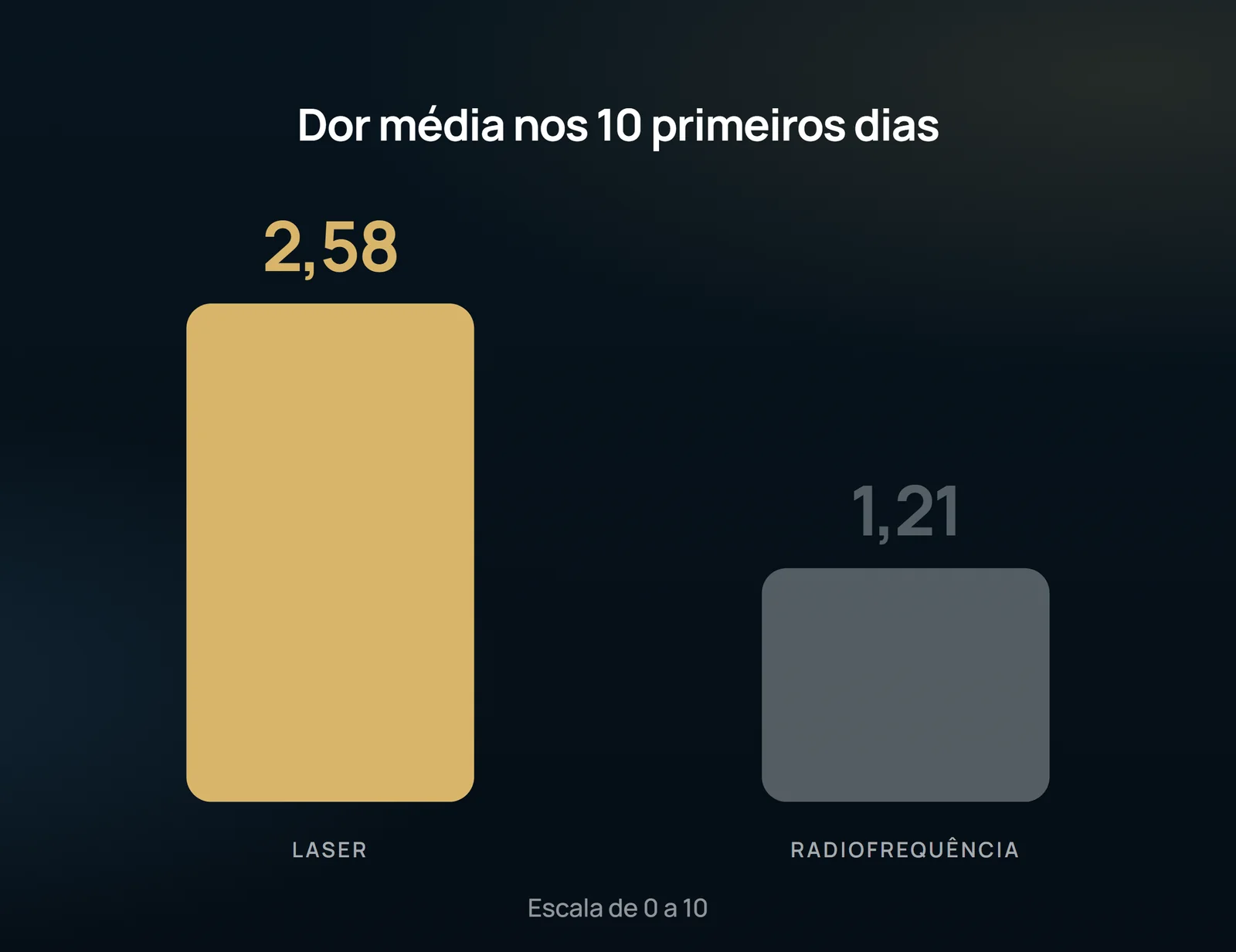
Patients recorded pain on a visual analog scale from 0 to 10 during the first 10 days. The averages (standard deviation) were 2.58 (2.41) for EVLA, 1.21 (1.72) for RFA, 1.60 (2.04) for foam and 2.25 (2.23) for stripping (P). < 0.001). There was no statistical difference between EVLA and stripping, nor between RFA and foam.
The absence from work, corrected for weekends, was 3.6 days in EVLA, 2.9 in RFA, 2.9 in foam and 4.3 in stripping. At 3 days, in the domains of body pain, physical functioning and physical role of the SF-36, radiofrequency and foam groups had significantly better scores; at 1 month the difference had disappeared.
Complications and relapse
Only two events were classified as major complications in 580 legs: one patient with iliac vein thrombosis and pulmonary embolism within a week after foaming, treated with catheter-directed thrombolysis, and one with popliteal vein thrombosis in the first month after stripping. Among the minors, superficial phlebitis was significantly more frequent in foam (17) and radiofrequency (12) than in stripping (5) and laser (4), with P = 0.006. Recurrent varicose veins in 1 year appeared in 11.6%, 7.3%, 13.8% and 14.8% of the legs, respectively, with no statistical difference (P = 0.155).
What the study does not authorize to state
The follow-up published here is one year: the article talks about early occlusion and recovery, not durability. For practical reasons, treatment and follow-up tests were not blinded. Within the laser arm there was variation of technique — 17 patients treated with 980 nm instead of 1470 nm and 20 in pulsed mode — although the sub-analysis showed no difference between wavelengths. And the whole cost comparison was built on the refund and productivity level of Denmark: the authors themselves claim that it may not apply directly to other countries. None of this elects a winner: the choice of technique remains duplex mapping, case by case.
Content addressed exclusively to health professionals. No individual result is guaranteed: the indication depends on clinical evaluation and imaging examination of each patient (CFM 2,336/2023).